
Why Old TVs Showed Color Bars and the “No Signal” Screen
If you grew up hooking a console up to a CRT, you know the ritual. Screw the RF adapter onto the antenna terminals, flip the TV to channel 3, and wait through a wall of grey static until the picture snapped into place. And if the cable was loose, or the station had gone to bed for the night, you didn’t get your game — you got a screen full of rainbow stripes, or a bouncing “NO SIGNAL” box drifting across a black void.
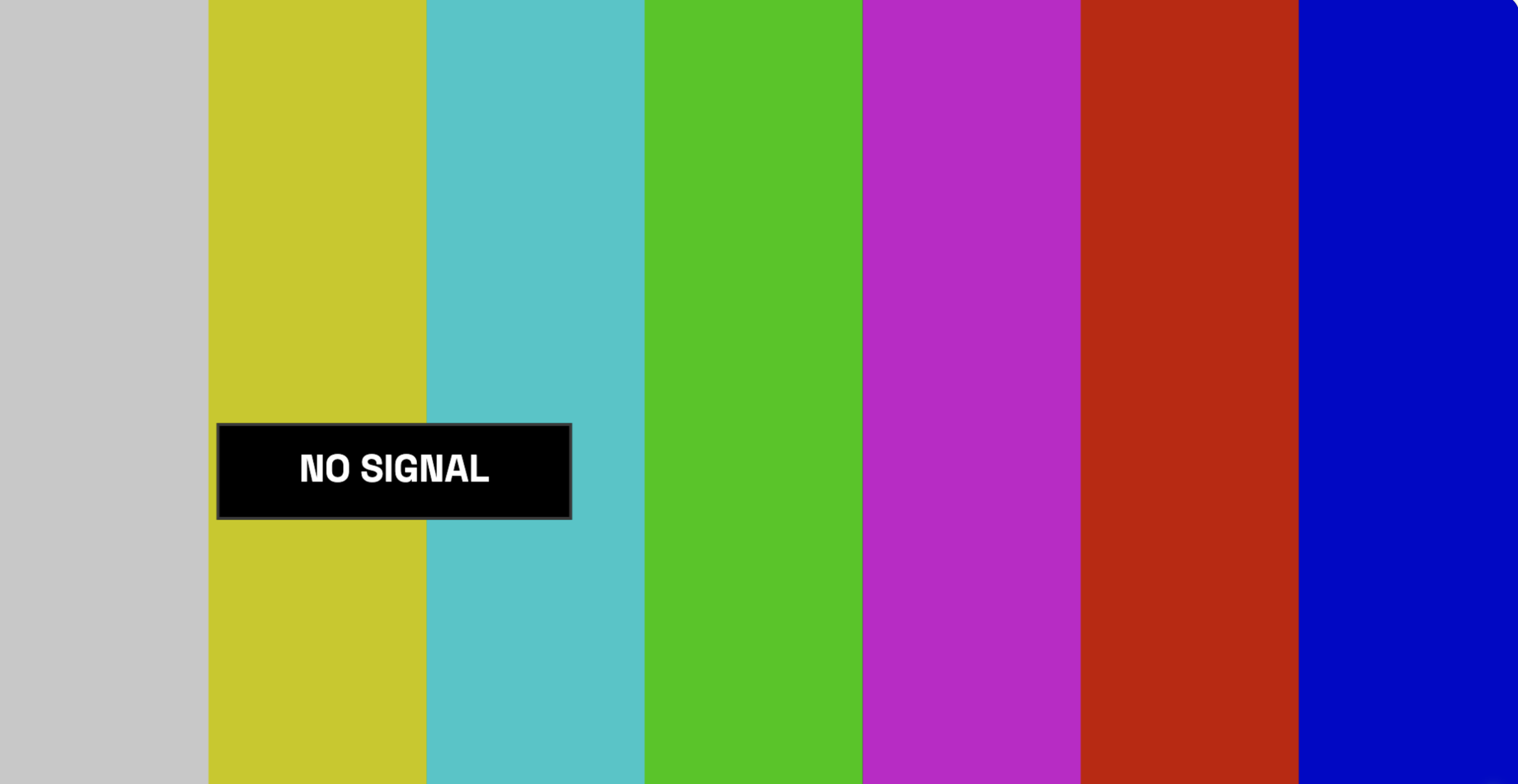
Those screens are burned into the memory of anyone who was there. But most of us never knew what they actually were, or why the television bothered to show them at all. It turns out both the color bars and the “no signal” screen were doing real jobs — they just happened to become some of the most nostalgic images in the history of the living room.
The color bars were a measuring tape for color
The rainbow of vertical stripes has a name: SMPTE color bars, standardized by the Society of Motion Picture and Television Engineers back in the 1970s. They look decorative, but every bar is a precise, agreed-upon reference value — the television equivalent of a ruler.
Read them left to right and you’ll notice they march from brightest to darkest: white (or grey), then yellow, cyan, green, magenta, red, and finally blue. That order isn’t random. It’s the bars arranged by descending luminance, which let an engineer check that the display was reproducing both color and brightness correctly in one glance.
Underneath the main bars, a proper test pattern hid even more tools: a strip of smaller blocks for setting the black level (the famous “PLUGE” pattern, which stands for Picture Line-Up Generation Equipment), and reference patches for tuning hue and saturation. Broadcast engineers would stare at these while nudging dials until everything lined up.
Why every station needed them
Here’s the part that’s easy to forget in the streaming era: an analog broadcast passed through a long, fragile chain of equipment before it reached your set. Camera, to tape machine, to the studio’s switching gear, to the transmitter, over the airwaves, into your antenna, through your TV’s tuner. Every one of those links could shift the color or drift the brightness.
The color bars were the fixed point everyone in that chain could trust. A camera operator could shoot the bars, an engineer down the line could confirm the reds were still red and the blacks were still black, and if something looked wrong, they knew exactly where to hunt for the fault. The bars were usually paired with a steady 1kHz audio tone for the same reason — a known reference so the sound could be lined up too.
So when a station flipped to bars, it wasn’t idle. It was calibrating — making sure that when the broadcast did start, your TV would show it the way the studio intended.
The test card that ran while the world slept
Television used to end. Stations signed off in the small hours, played the national anthem, and left a test pattern on screen until morning. That’s why so many people remember drifting off — or waking up too early — to a silent card of color bars and a low hum. It was the sound and picture of a channel that was alive but had nothing to say yet.
Different countries had their own famous test cards. British viewers grew up with the BBC’s Test Card F and its girl-and-clown image; American sets once showed the Indian-head test pattern. But the SMPTE bars became the universal shorthand, the one everybody pictures when they think “old TV, nothing on.”
“No Signal,” snow, and the sound of static
The color bars meant the station is fine, just standing by. The other screen — the one every retro gamer knows — meant there’s nothing here at all.
On a pure analog set, an empty channel showed “snow”: a storm of random black-and-white dots with a harsh hiss. That noise was real — it was the TV amplifying faint radio energy from the atmosphere and even the leftover heat of the early universe, turned into flickering dots because there was no broadcast to drown it out. Later televisions got politer about it, muting the snow and putting up a plain blue screen or a tidy “NO SIGNAL” message that floated around the display so it wouldn’t burn into the phosphors.
Why it hits different for retro gamers
For most people these were just the textures of broadcast TV. For anyone who gamed on a CRT, they were part of the experience itself.
Picture firing up a Nintendo in 1985. Super Mario Bros. had just landed, but before you could set foot in the Mushroom Kingdom you had to get past the television itself: screw in the RF switch, hunt for channel 3, and sit through a burst of snow until the signal locked and that bright blue World 1-1 sky finally appeared. The static wasn’t part of the game, but it was absolutely part of playing it — the last obstacle before the first Goomba. That snow was the anxious moment between plugging in a cartridge and the title screen appearing.
The “no signal” box was the sinking feeling that the RF switch had wiggled loose again, or that channel 3 versus channel 4 was set wrong. Getting a clean picture was a small victory you earned every single time you sat down to play.
That’s why these screens carry so much weight now. They aren’t just old technology — they’re the border between “not playing yet” and “playing,” rendered in static and stripes.
Bringing the bars back
Here’s the catch: modern displays will almost never show you any of this. A flat panel with no input just goes dark or pops up a manufacturer’s logo. The color bars and the drifting “NO SIGNAL” badge simply aren’t part of a screen’s life anymore, which is exactly why they feel like such a specific, vanished era.
If you want them back — as set dressing for a retro corner, a prop in a video, a stream intermission, or just a hit of nostalgia — you can open the SMPTE bars and the bouncing “NO SIGNAL” box on any modern monitor or TV over at BlankScreen. Cast it to the CRT-shaped TV in the background of your setup and, for a moment, it’s 1994 and the station has signed off for the night.
The bars were only ever meant to be a technical tool. Somewhere along the way they became a feeling — and that feeling is worth keeping around.